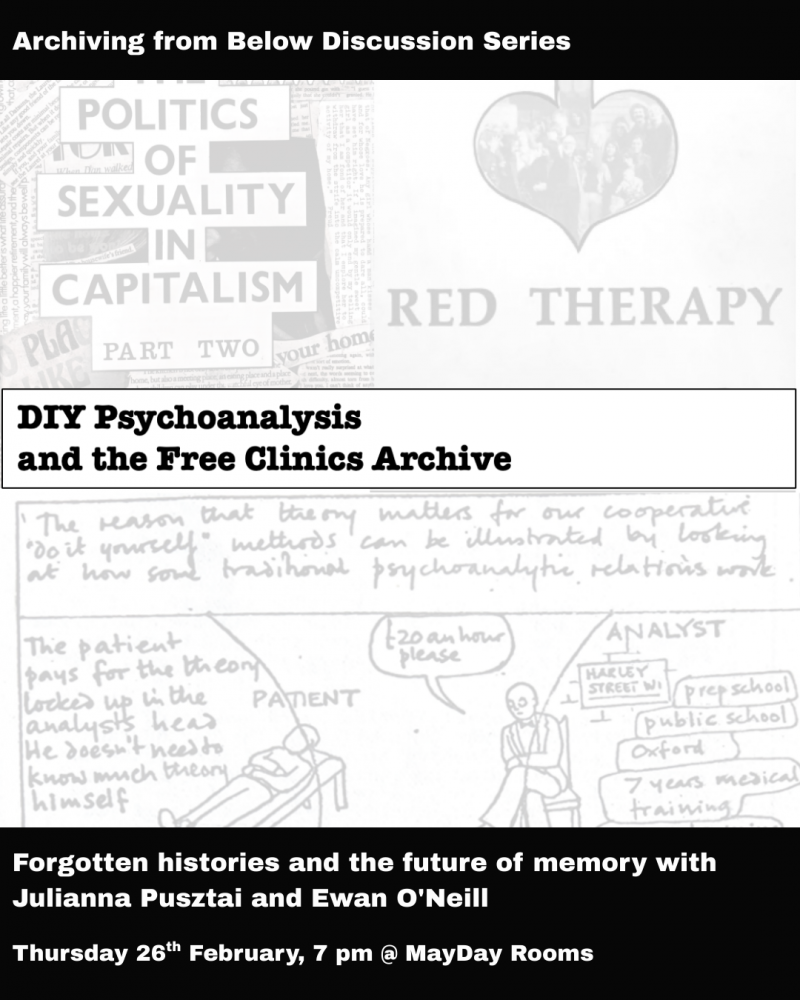
DIY Psychoanalysis and the Free Clinics Archive: forgotten histories and the future of memory with Julianna Pusztai and Ewan O'Neill
Ticket(s)
Event Details
For the next event on our 'Archiving from Below' series we invite two researchers from the Freepsy Research Collective: ‘Free Clinics and a Psychoanalysis for the People: Progressive Histories, Collective Practices, Implications for our Times’ to discuss historical findings from free clinics, grassroots psychoanalytic groups and the future of memory.
The first part will explore DIY psychoanalytic movements in the 1970s in the UK, including the Barefoot Psychoanalyst, the Red Collective, and Red Therapy. Feminist and liberatory social movements of the time critiqued traditional psychoanalysis and implemented new DIY psy practices that addressed how power is maintained through capitalism and political oppression. This history showcases a horizontally structured psychoanalysis that is both a clinical and political exercise, organised in a very particular manner: the hierarchy between patient and analyst is consistently challenged, reassessed, and modified. DIY methods and self-help in this framework imply mutuality and a horizontal relationship based on the exchange of skills, knowledge, and resources rather than hierarchy. In this session, we will grasp historically both hope and despair: examples of activism, psychoanalysis, and mutual care as a collective practice of experimentation.
The second part of the session will encourage us to think together about changing archives and archival practice, especially in relation to collective and social memory. We ask how new collaborative relationships between archives and their users are developing the future of memory. With the notion of the traditional archive dismantling, we'll also look at how this reconfiguration of the archive is shifting the mode from exclusivity to inclusivity, a central theme shared with the free clinics.
You will encounter archival objects from the UK to Brazil that record and retell a history of psychoanalysis as a practice from below. This session will be interactive and open to experimentation, sharing ideas, and, hopefully, helping us link past and present while imagining the future of psychoanalysis and a network of free clinics. The printed records are proving that psychoanalysis belongs to the social link as much as to our internal space —a shift from the consulting room to the public sphere. All are welcome.
Julianna Pusztai is a London-based, Hungarian psychosocial and psychoanalytic thinker and clinician. She is a member of the Feminist Laboratory and the co-founder of the Sándor Ferenczi Collective. She is a PhD Candidate researching grassroots psychoanalytic collectives at Freepsy, University of Essex.
Ewan O’Neill is the archivist/researcher at Freepsy, University of Essex, where he is building the Free Clinics Archive that is soon to transfer to the Mayday Rooms Archive. He is also the archivist at the British Psychoanalytical Society in London and the European Psychoanalytical Federation in Brussels.